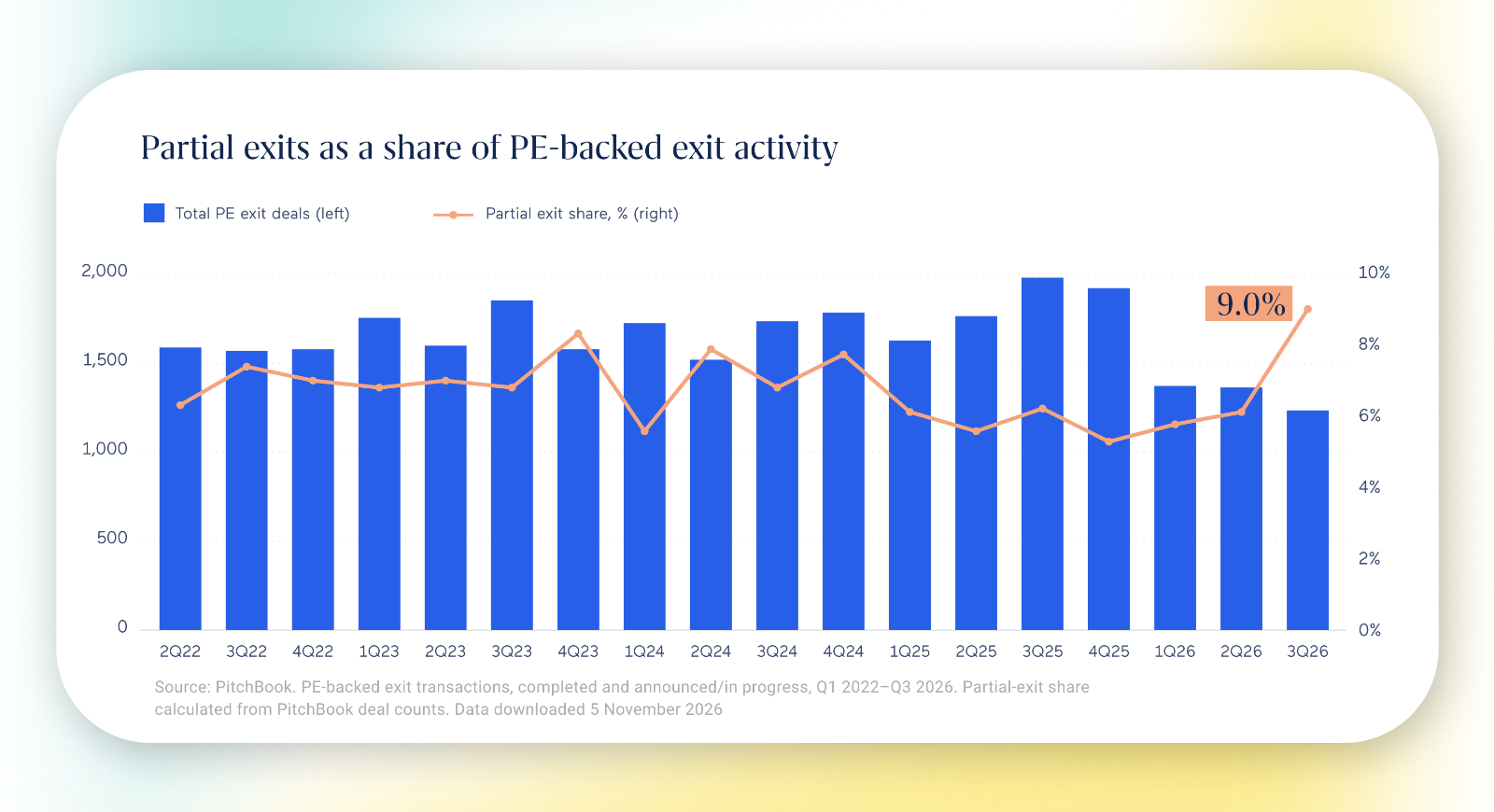
Faced with greater uncertainty, private equity firms are having to explore more flexible divestment strategies
Market uncertainty is increasingly becoming a challenge for private equity firms looking to exit, making it harder for buyers and sellers to find common ground on valuations. As such, compromise has to be reached, and more firms are settling for partial exits, offloading as much of their stake as possible while retaining the rest. This, of course, means exit strategies have to be amended.
The data shows just how challenging the current environment is for private equity firms attempting to liquidate their holdings and exit positions. The number of private equity exits slowed during the first half of 2026, as market uncertainty continued to prevent buyers and sellers from finding common ground on valuations.
Global private equity and venture capital firms announced 1,504 exits between January 1 and June 30, down 6% from the 1,601 exits recorded in the first half of 2025, according to S&P Global Market Intelligence data. Christian Mitchell, managing partner at North Star Partners, sees this as stemming from differing views around valuation.
He explains that for older or more challenged assets, buyers often aren’t prepared to pay what the business is valued at in the fund’s books. Meanwhile, GPs will be reluctant to sell below those marks because they don’t want their LPs to lose confidence in them.
Christian Mitchell, managing partner at North Star Partners
“For most GPs, waiting for the right buyer is no longer realistic when LPs are asking for cash to be returned,” says Mitchell. “The right route for a GP depends on the fund’s remaining life as much as the asset itself. For a strong asset in a fund with time left to run, a minority sale is often the more attractive option, whereas a fund nearing the end of its life will tend to lean towards a continuation vehicle.”
The challenges partial exits pose
The exit point of a private equity investment strategy can sometimes be the most perilous, given this is when the years of work come to fruition. Exit strategies will be carefully planned out as a result, but partial exits raise additional challenges to circumvent.
For one, the sale of a minor stake in a portco is not as desirable for buyers as the entire thing, which can complicate the terms of any deal. Mitchell explains that, given a minority investor will end up with less control, they will normally look for added protections in the form of preferred return, a minimum multiple on exit or even a veto over a sale below a certain price.
“These protections are often how buyer and seller close a gap on valuation, but it means the agreed price isn’t the full picture,” says Mitchell. “Funds have to look at the price and the terms together, and model how the eventual full exit plays out with those rights in place before anything is agreed.”
This is on top of the extensive work already required by a private equity firm when making preparations to sell down stakes in a portco. Reed Smith partner Brendan Gallen sees a need for more work and scrutiny to be required, while all the “usual exit disciplines” still apply.
Brendan Gallen, partner at Reed Smith
“Clean financial reporting, a credible business plan and an equity story the market can believe in — these matter even more where the seller is keeping a stake and the buyer is effectively underwriting the sponsor’s continued stewardship,” says Gallen. “A robust, independently supported valuation is also critical. It anchors pricing and is central to managing the conflicts that arise when the GP sits on both sides.”
Another departure can be the mindset involved. A traditional exit often means a clean break for a sponsor, bringing to a culmination their hard work with all required metrics achieved. A partial exit, however, means the start of a new relationship with the private equity firm retaining exposure alongside a new party. According to Gallen, this new dynamic requires a fair process with meaningful Limited Partner Advisory Committee (LPAC) involvement.
“Economics change too,” he adds. “Carried interest may be fully rolled or crystallized and partly rolled, and new carry and fee terms are set for the continuation vehicle. Investors and regulators, including in the UK and EU, are increasingly focused on transparency in these deals. The process therefore carries a heavier documentation and disclosure burden than a conventional sale.”
What the future holds for partial exits
The rise in partial exits is a reflection of the challenging environment private equity firms are having to navigate. Given these conditions – elevated rates, market volatility, subdued M&A activity and so forth – are set to remain for the foreseeable future, it is natural that exits could continue to be constrained as well. Faced with a backlog of unrealized assets, and with LP pressure for distributions not likely to ease quickly, the fact that partial exits have provided a solution for so many firms leads Gallen to expect them to retain their usefulness.
“Dedicated capital, more experienced buyers and established market practice mean continuation vehicles and minority sales are now regarded as a mainstream portfolio management tool, not a last resort,” he adds. “We are also seeing more single-asset and multi-asset continuation funds, and growing interest from evergreen and semi-liquid vehicles as buyers.”
Partial exits have allowed private equity firms to continue their strategies and to flexibly change tack as they look to realize value from portfolios, and expectations around these could normalize as popularity increases. However, Mitchell points out that partial exits only help in the short term and this can be an issue for private equity firms’ overall strategies.
“The rest of the stake still has to be sold eventually,” explains Mitchell. “For a GP that needs to return cash, it’s a sensible step, but if the real issue is that the GP isn’t willing to accept what the market will currently pay, a partial exit doesn’t change that, and the same question will come up again when the rest of the stake goes to market.”
End-to-end platform for private debt.
Run deals faster. Track covenants in real time. Strengthen portfolio oversight.